
VR Combat Sound Design & Wwise Implementation — Case Study
VR Combat Sound Design & Wwise Implementation — Case Study
Combat in Reave is physics-driven and player-controlled, meaning every swing, clash and impact must feel immediate and grounded. Because the player’s physical movement directly drives combat, the audio needed to reinforce weight, speed and contact precision without becoming repetitive or overwhelming in VR.
Challenges:
Variable swing speeds
Physics-based hit detection
Multiple surface types
Avoiding repetition fatigue
Maintaining clarity in 3D space
Performance constraints in VR
System Design in Wwise
Velocity-Driven Swing System
Each melee weapon’s swing intensity was driven by an RTPC mapped to weapon velocity, allowing audio layers to scale and trigger dynamically.
Higher-velocity swings introduced assets with sharper transients and additional high-frequency detail to reinforce perceived force. Medium swings triggered softer variants, while low-velocity movements produced no swing audio — preventing unnecessary noise during subtle weapon handling.
This ensured that audio feedback directly reflected player intent, strengthening physical embodiment within VR.
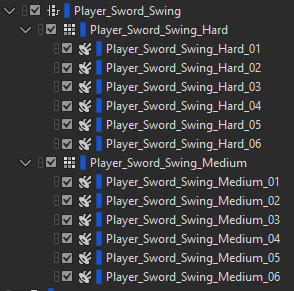
Wwise setup of the Switch Container containing the assets for two different swing strengths: Hard & Medium
Impact Triggering & Material Switching
Impacts were designed as layered, bespoke recordings and triggered as singular events.
Surface-based switch containers provided material-specific variation across seven distinct surface types. Random containers were used to reduce repetition during extended combat encounters.
In addition to surface type, impact intensity was categorised as soft, medium or hard. Rather than scaling a single asset via RTPCs, I recorded distinct impact recordings at each velocity level. Metal objects resonate and respond differently depending on strike force, and capturing those behaviors authentically produced significantly more convincing results.
Although this approach required extensive original recording, it introduced a level of physicality and realism that procedural scaling alone could not achieve.
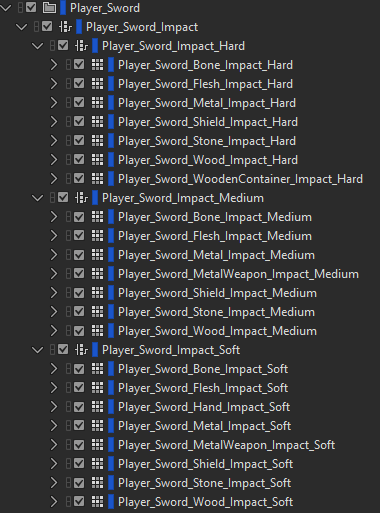
The Wwise Switch container with all the assets for 3 Impact Strengths: Soft, Medium & Hard. Across 7 different surface types.
VR Considerations
In VR, spatial clarity and mix definition are essential.
Voice limiting and prioritization ensured that critical combat feedback remained intelligible, even during multi-enemy encounters typical of Reave’s extraction gameplay. Standard mix-ducking techniques were implemented to preserve weapon presence while maintaining overall scene clarity.
The system was built to remain responsive without contributing to fatigue or audio clutter — a key consideration in extended VR sessions, where user comfort always has to be taken into account.
Why It Was Designed This Way
The goal of this system was to maximize weapon responsiveness and reinforce the physicality of VR combat.
By mapping swing velocity directly to audio behavior and capturing distinct impact recordings across multiple intensity levels, the system responds naturally to player input. This strengthens immersion and ensures that combat feels weighty and responsive rather than just cosmetic.
The structure was also designed to be scalable, allowing consistent behavior across multiple weapon types while maintaining performance stability within VR.
If you’re looking for an experienced freelance game sound designer to design and implement scalable audio systems, feel free to get in touch.